- Home
- LED Display Guides
- LED Video Wall for Retail: Placement & Distance
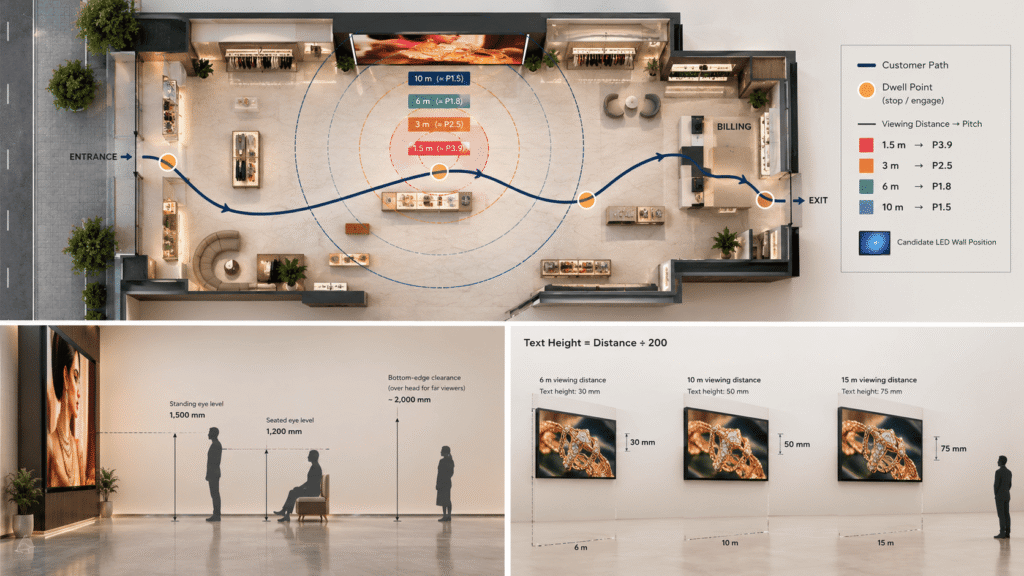
Table of Contents
A retail LED video wall succeeds or fails on three decisions that have little to do with the screen’s brand or brightness rating: where it sits, how far away the people looking at it are, and what runs on it. Get those three right and an ordinary wall earns its place.
Get one wrong and an expensive wall gets walked past.
This guide is for retail store owners and managers, whatever the format: a single boutique, a multi-floor showroom, or a store inside a mall. It draws on 11+ years of specifying and installing LED video walls for retailers across India. Working in jewellery or clothing and textile? Our jewellery showroom guide go deeper on those formats.
1. Start With the Job the Wall Has to Do
Placement, distance and content all follow from one earlier decision: what the wall is for. Choose one primary job and, at most, one secondary:
- Pull footfall in from the street or the mall corridor
- Lengthen the time customers spend on the floor
- Push particular categories or higher-margin lines
- Tell the brand or craft story that justifies your pricing
- Make waiting at trial rooms, billing, consultations – feel shorter
A wall meant to pull footfall belongs at the frontage and needs brightness.
A wall meant to tell a craft story belongs where customers pause and need detail.
Without a job, the wall goes wherever there’s space, and that’s rarely where it’s useful.
2. Placement: Put the Wall Where Attention Already Is
Walk the store as a customer would: from the street (or the mall corridor), through the entrance, across the floor, to billing.
Do it on a busy day and a quiet one, and mark four things:
- Where people slow down or stop — displays, counters, seating, trial rooms
- Where people wait — queues, consultations, seats for family members who’ve come along
- What a customer sees at eye level from the entrance and from each dwell point — your real sightlines, not the floor plan’s
- Where light interferes — window glare, spotlights, reflective finishes
The rule that follows: place the wall where attention already is, not where there happens to be spare wall. A wall at a natural dwell point earns attention without trying.
Then check what’s physically behind each candidate wall: power, structure, and whether anyone could ever get behind it to service it. Our installation requirements guide and front access vs rear access guide cover that side.
Give each zone a role, and let the role decide the category:
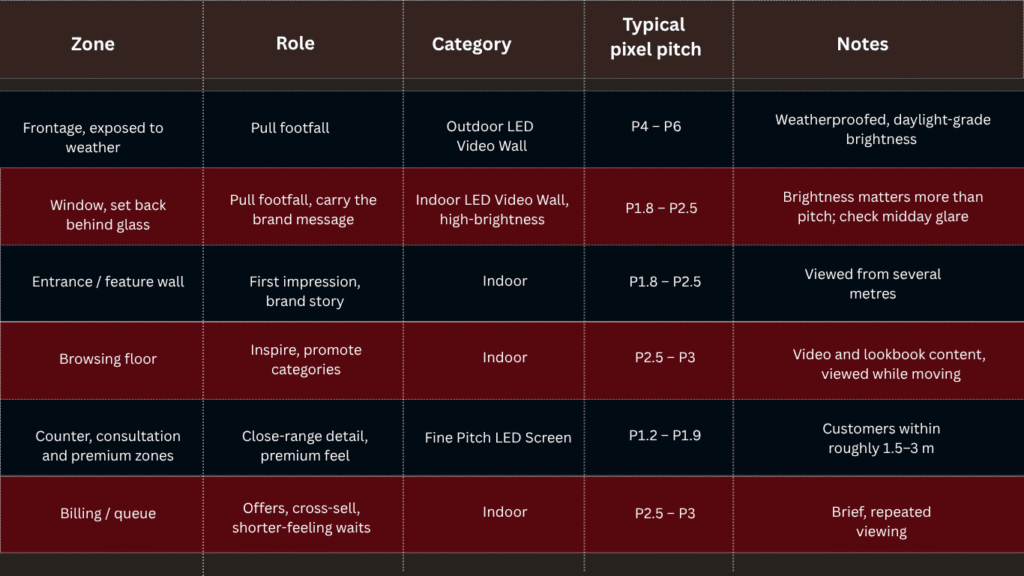
Most stores end up with one or two categories across their zones, not all three. Don’t pay for outdoor-grade or fine-pitch capability in a zone that doesn’t need it.
3. Viewing Distance: Retail Is Not a Boardroom
Our viewing distance guide sets out the method for a seated, fixed audience. Retail breaks those assumptions: your viewers are standing, moving, arriving from several directions, and often seeing the wall at an angle.
The principle still holds:
- Your closest viewer sets the pixel pitch,
- Your farthest viewer sets the size.
but you measure it differently.
- 3.1 Measure per zone, not per store:
For each candidate wall, pace out the closest point a customer will realistically stand and the farthest point where you still want the wall to land.
- 3.2 The closest viewer sets the pitch:
As a working rule, the full derivation is in our viewing distance guide, the minimum comfortable viewing distance in metres is roughly the pixel pitch in millimetres, and comfortable viewing starts at two to three times that.
Our pixel pitch guide explains how to apply it.
- 3.3 The farthest viewer sets the size:
A wall that’s sharp up close but too small to register from the entrance is doing half its job.
These are starting ranges, not rules. Your own paced-out distances decide.
- 3.4 Standing eye level and mounting height
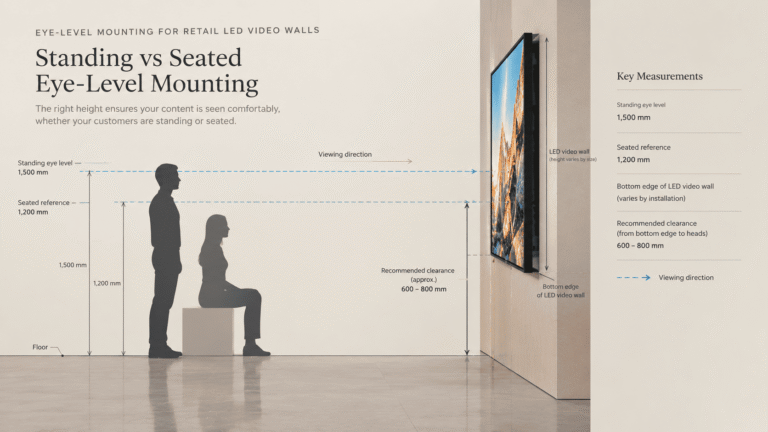
Boardroom guidance assumes seated viewers. In a store they’re standing: so the default eye level for standing viewers is 1,500 mm, against 1,200 mm seated.
For close-range walls, centre the content near standing eye level.
For a wall read across a busy floor, the bottom edge has to clear the heads of people standing between the wall and the viewer.
Test it on site: stand where the farthest intended viewer stands, with someone in front of you.
- 3.5 Viewing conditions
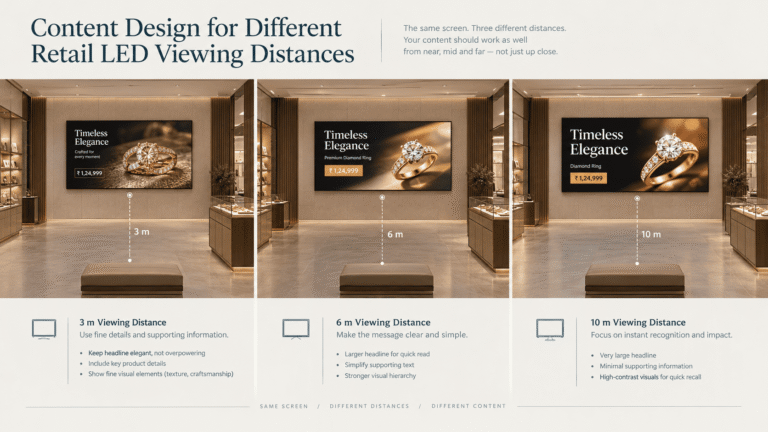
Customers may see the screen from different distances as they move through the store.
Consider the typical viewing distance and how the content will appear from nearby aisles, display areas and the main customer path.
The screen should remain clear and easy to read in the places where customers are most likely to notice it.
- 3.6 Glare and brightness
Window glare and spotlights can wash out a wall faster than pixel pitch can fix. Check the position at the brightest time of day, and match brightness to the real ambient light rather than a default.
4. Content Considerations
The wall is a one-time purchase. The content is a permanent commitment. Settle these before you choose hardware.
- 4.1 Design for the farthest viewer
A wall is read in seconds, usually by someone doing something else.
A customer 6 metres away needs text at least 30 mm tall on the wall, and anything you want read at a glance should be larger. Large type, short loops, one idea per scene. Content built for a phone screen or a flyer rarely survives the translation.
- 4.2 Match content to the zone
- Frontage and window: bold, high-contrast, readable in a few seconds.
- Entrance and feature walls: brand film, lookbooks, collection launches.
- Browsing floor: slower storytelling, styling ideas, craft.
- Counter and consultation: close, detailed, unhurried.
- Billing: offers, add-ons, loyalty. One loop rarely suits every zone.
- 4.3 Build to the wall's native size
Retail walls are often custom shapes rather than 16:9. Ask your vendor for the wall’s exact pixel dimensions and safe areas, and produce content to those instead of stretching standard video to fit.
- 4.4 Decide who makes it, and how it changes
In-house, an agency, or a mix. Content production is a real budget line, not a footnote.
Plan a refresh cadence you can keep, tied to your real calendar: collection launches, festive and wedding seasons, sale periods.
If you run several stores, push content centrally rather than updating each screen by hand. Remote support for software and technical issues also matters more than it sounds when whoever manages the content isn’t a technician.
And if you stock several brands, decide early whether brands might fund content slots, since the content system has to schedule them cleanly.
Luxury Retail: Where These Three Decisions Get Stricter
Luxury retail changes the brief: the wall has to belong to the space, not announce itself.
- Fine pitch for close viewing: In boutique and counter zones, customers are often roughly 1.5 to 3 metres away, so P1.2–P1.8 is the usual starting range. Our fine pitch LED display range is built for this.
- Looks right at low brightness: In calm, dimly lit interiors a close-viewing wall usually runs well below its peak. Ask about grayscale performance at low brightness: weaker panels lose tonal detail when dimmed, which shows first in dark, rich content.
- Reads as architecture: Flush mounting, clean edges, concealed cabling, and a finish that suits the store’s materials. This is where front-access servicing earns its place: a flush wall with no rear corridor can still be repaired without opening up the surrounding walls. Confirm the exact clearance behind the wall with your vendor.
- Quiet: In a hushed showroom, fan noise is as noticeable as a flickering light. Ask about operating noise.
- Colour you can trust. Calibration, and uniformity across the whole surface, so no module ever looks a shade different from its neighbour.
- Editorial content, not promotions. A luxury wall works best with slow, cinematic, brand-led content, closer to a fashion film than a sale banner. Fewer scenes, held longer, made well.
Before You Commit! Think about Budget, Timeline and How You'll Judge It
Three shorter decisions that determine whether the wall keeps earning its place after installation.
- Budget the whole wall, not just the panels
Ask every vendor to quote six lines separately: the wall; structure and mounting; electrical work, installation and commissioning; the control and content-management system; content production; and AMC and support. Our buying checklist covers how to compare the quotes.
- Work the timeline backwards
Start from the date the wall must be live, whether a festive season or a launch, and allow for site assessment, quotation, approvals, ordering, installation and content readiness before it.
If you lease the premises, find out early what your landlord or mall management must approve: storefront displays, structural fixings, extra electrical load.
- Define success before installation
Pick two or three measures tied to the wall’s job:
- Door counts
- Time spent in the zone
- Sales of featured categories in weeks (with and without wall content) and record a baseline first
Your One-Page Planning Worksheet
Before you request a single quote, you should be able to answer these below:
- What is the wall's one primary job?
- Where do customers slow down, wait and look, and which of those spots will carry a wall?
- For each zone, what are the closest and farthest viewing distances, paced out on the floor?
- What pixel pitch and category does each zone need, set by those distances rather than by a quote?
- Have mounting height and the bottom edge been tested against real sightlines?
- What will run on the wall, who makes it, and how often does it change?
- Will content be produced to the wall's native pixel dimensions?
- Does the budget cover structure, installation, content management, content production and AMC, not just panels?
- What's your live-by date, and what does the written timeline look like working back from it?
- What will you measure, and what's your baseline today?
If you can answer these, any competent vendor can give you a precise quote.
If you can’t, that’s what a site assessment is for.
How We Plan Retail Projects
We start every retail project on the shop floor: walking the customer’s path, measuring the closest and farthest viewing distance in each zone, and agreeing the wall’s job before a spec is written.
That’s why our LED experts walk clients through the complete investment, from hardware and installation to content management, maintenance and after-sales support.
Every installation comes with a 2-year warranty, AMC, in-house repair and remote support, backed by 11+ years of experience across India and 219 Google reviews.
Or need help with an already existing LED wall?
Our in-house technical team also provides service and repair support for LED displays installed by other vendors too, helping businesses get their existing screens back to performing as they should.
Planning a retail LED wall and want a second pair of eyes on the plan?
Get a free site assessment or WhatsApp us your store layout and a few photos for a faster first read.