
- Home
- LED Display Guides
- How to Choose the Right LED Video Wall for a Jewellery Showroom
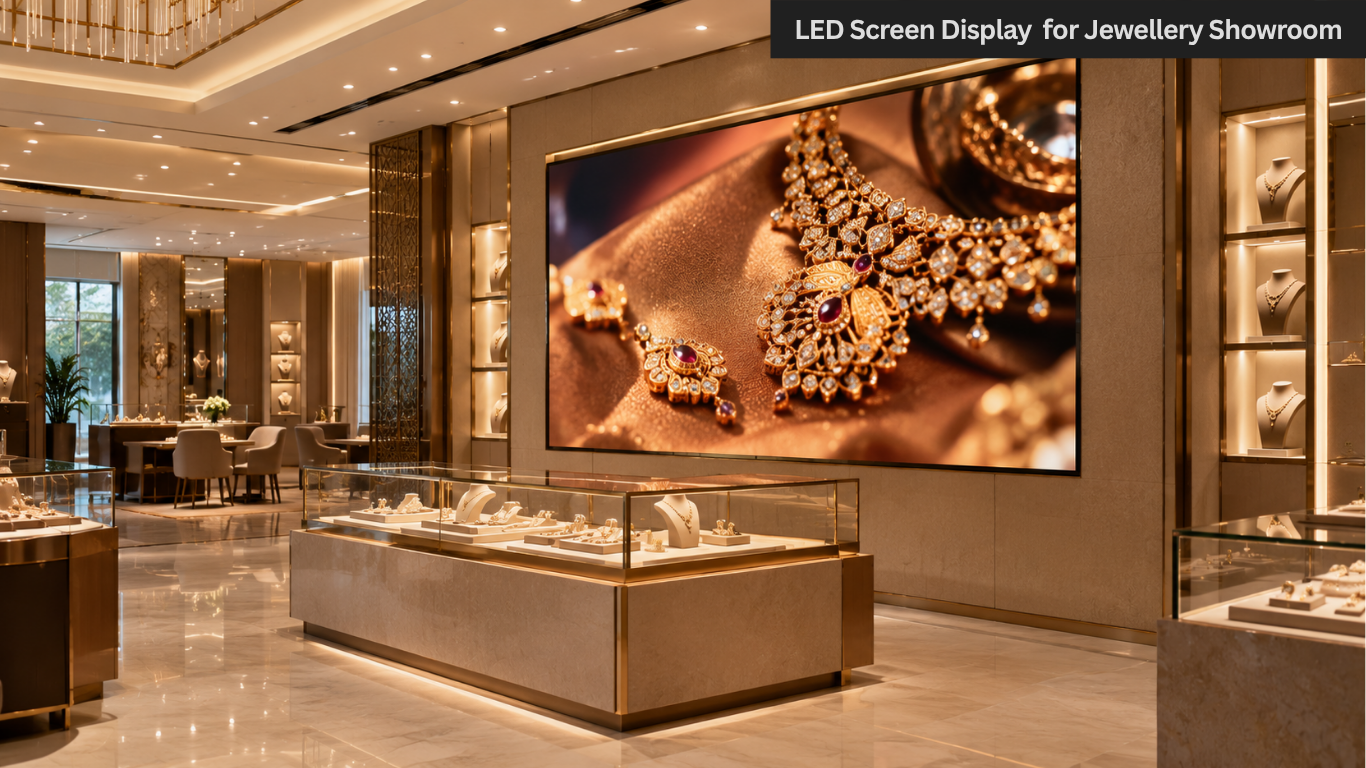
Table of Contents
A jewellery showroom sells trust and craftsmanship before it sells gold.
Everything in the store: the lighting, the counters, the finishes, all are designed to signal that.
An LED video wall behind the counter or across the storefront either reinforces that signal or undercuts it, and the difference usually comes down to specification choices that have nothing to do with how “big” or “bright” the wall is.
We’ve installed LED screen displays for jewellery and textile showrooms across India for 11+ years, so this guide covers what actually matters when specifying one: where it goes, what spec it needs, what to put on it, and what it should cost.
Why Jewellery Showrooms Need a "Different Spec" Than Most Retail
Three things make jewellery genuinely different from general retail signage:
a. Viewing distance is short and the audience is captive
Customers often stand close to the screen rather walking past at speed. This usually makes a finer pixel pitch more suitable than what you might choose for a typical outdoor or storefront display.
That pushes toward a finer pixel pitch than most retail applications need, in line with what we cover in our viewing distance guide.
b. The wall is a trust signal, not just a display
A jewellery purchase is a considered, high-value decision. A wall that looks premium, current, and well-maintained reinforces that; a static, outdated, or malfunctioning one quietly works against it, in a way a plain sign never would.
c. Color accuracy matters more here than almost anywhere else
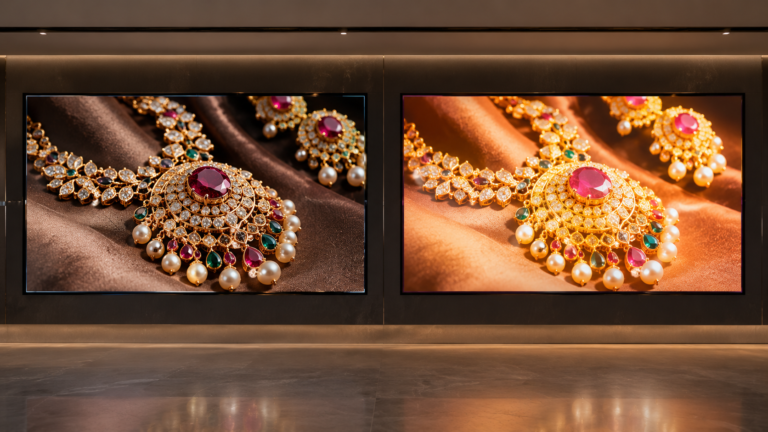
If the wall ever shows product content, new collection videos, or close-up shots of a piece's craftsmanship, an inaccurate display can make gold look brassy or a stone's colour look flat.
This is a display calibration question, not a store-lighting question (your showcase spotlights and your video wall are solving different colour problems).
But it’s worth asking your vendor directly how the display is colour-calibrated if product content is part of the plan.
Where the Wall Goes: Storefront, Interior or Both
Most jewellery showrooms end up considering both zones, and they’re genuinely different specification decisions:
- Storefront / window-facing:
Pulls foot traffic from the street, competes with daylight, and needs enough brightness and if it’s street-facing, then the weatherproofing to hold up outdoors.
This is where our indoor vs outdoor guide is worth reading before you spec anything, since the two categories aren’t interchangeable.
- Interior / counter backdrop:
This screen is viewed from close range, so image clarity and fine detail matter more than high brightness.
A finer pixel pitch is usually a better choice for this type of indoor application.
See our fine-pitch LED displays to understand the options better.
- Mall Showroom or Street-Facing Store:
If your jewellery showroom is inside a shopping mall, you may have limited control over exterior displays due to mall guidelines.
In this case, a strong indoor LED wall visible from the mall walkway can be more useful.
For a standalone showroom on a busy street, an outdoor LED screen or storefront-facing display can help attract attention from passing customers.
Color Accuracy: Worth Asking About Directly
If the wall will show anything beyond abstract branding: product videos, close-up shots of a piece, a new collection reveal — the display’s colour rendering is doing real work.
A display that skews warm or cool, or has a narrow colour range, can make gold appear a shade off from how it looks in the case a few feet away, which is exactly the kind of inconsistency a jewellery buyer notices even without being able to name what’s wrong.
This isn’t something most retail signage buyers need to think about, for a branding-only wall showing text and logos, it barely matters
For jewellery, it’s worth a direct question to your vendor: how is the display calibrated, and can you preview actual product content on the physical wall before go-live rather than trusting how it looks on a laptop screen.
Content Ideas That Actually Sell
A wall showing the same static graphic for six months is money left on the table. A few genuinely jewellery-specific content ideas worth planning for from day one:
- A live gold/silver rate ticker
Small, rotating element showing current rates is a familiar, trusted format in Indian jewellery retail store environments, and signals transparency the moment someone walks in.
- New collection launches
Timed to festival and wedding season peaks rather than running on a generic loop year-round.
- Craftsmanship content
Short videos on how a piece is made, which plays to exactly the “trust and craftsmanship” positioning a showroom is built around.
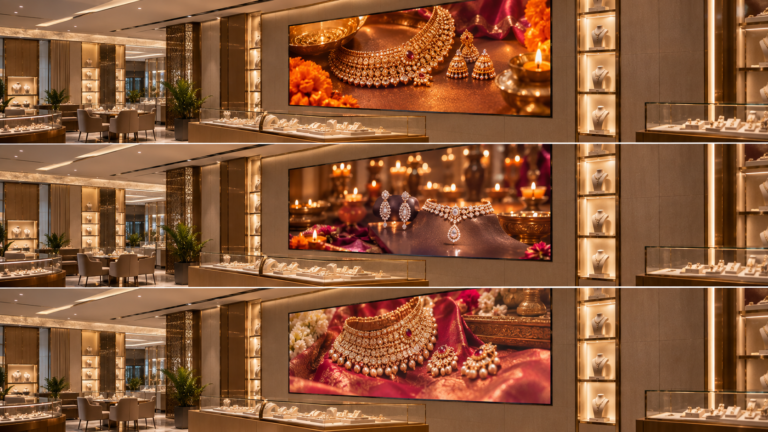
- Festive campaign content
For Akshaya Tritiya, Diwali and the wedding season window, planned and swapped in advance rather than improvised.
None of this requires new hardware, it requires a content plan and someone responsible for updating it, which is worth deciding before installation, not after.
The image below shows how LED screens can be used with different content for different occasions.
To explore how LED screens can be used across different retail spaces, see our LED display screens for retail.
Mistakes Made While Choosing LED Screen For Jewellery Space
1. Specifying pitch by "wow factor" instead of actual viewing distance
The counter's typical customer distance should drive the pitch decision, not how impressive a finer pitch sounds in a sales conversation.
2. Skipping a physical colour check before go-live
Product content that looks fine on a laptop can render differently on the actual wall, so preview it in place, not just on a monitor.
3. Under-speccing brightness near glass frontage
A wall that looks perfect in a dim interior can wash out completely a few metres from a sunlit window.
4. No content plan beyond launch day
The wall that never changes stops earning attention within weeks — plan who updates it and how often before installation, not after.
5. Treating uptime as an afterthought
A broken wall during festival season, your highest-traffic weeks is the worst possible time for a maintenance gap. Confirm AMC response times before you need them.
How We Approach Jewellery Showroom Installations
We start with where customers actually stand and what the wall needs to show, not a default spec.
That’s produced fine-pitch counter installations and storefront displays across India, a 2-year warranty, and pan-India AMC, so a wall that’s central to your busiest season doesn’t become a liability during it.
Planning an LED wall for your showroom?
Get a free site assessment or WhatsApp us your room dimensions for a faster first read.