- Home
- LED Display Guides
- Indoor vs Outdoor LED Video Wall Guide
Table of Contents
“Indoor” and “outdoor” sound like a location preference. They’re actually two different engineering problems, and mixing them up is one of the more expensive mistakes a first-time buyer can make either overpaying for weatherproofing nobody needed, or under-specifying a display that fails outdoors within a season.
We’ve installed both across multiple locations for 11+ years — showroom walls, boardrooms, auditoriums, storefronts, facades and hoardings outdoors.
This guide compares them honestly, including where the real cost differences come from, so you’re speccing the right category before you request a quote.
The Core Difference: Environment, Not Just Electronics
An outdoor LED wall isn’t an indoor wall with a weatherproof shell bolted on.
It’s built from the ground up for direct sunlight, monsoon exposure, temperature swings, and years of unattended operation, while an indoor wall is engineered for a controlled room, closer viewing, and a completely different brightness and pitch range.
Neither is a “better” product. They’re specified for different jobs
1. Brightness & Visibility:
Outdoor displays compete with direct sunlight; indoor LED displays don’t. That single fact drives most of what follows. Indoor walls typically run in the 800-1,200 nits range, while outdoor installations commonly need 6,000 nits or more just to stay legible at midday and displays facing direct sun or reflective surfaces often need more still.
Pixel pitch follows the same logic: indoor walls are usually viewed much closer, so they run finer pitches, while outdoor walls are typically viewed from further away and can run coarser pitches without any loss of perceived quality.
We cover this relationship in full in our pixel pitch guide — the short version here is that brightness and pitch are the first two specs that diverge sharply between the two categories.
2. Weatherproofing & Durability:
This is where the two categories genuinely stop being comparable.
Outdoor cabinets need to be sealed against dust and water; IP65 is the standard reference point with materials and coatings that hold up through direct UV exposure and India’s monsoon season without degrading.
Indoor cabinets have none of this requirement, because they’re never expected to face it.
Weight reflects this difference too: indoor cabinets typically run in the range of 8-18 kg per square metre, while outdoor cabinets built with thicker, sealed housings commonly run 25-50 kg per square metre.
That weight difference isn’t incidental; it’s the sealing and structural reinforcement outdoor conditions demand.
3. Weight, Structure & Wind Load
Indoor walls mount flat against an interior wall or structure, the way most fixed indoor installations do.
Outdoor walls are a different structural problem entirely, wind load becomes a real design factor, not a formality.
In India, outdoor installations are generally assessed against IS:875 Part 3, the Indian Standard covering wind loads on structures, and larger installations typically need a structural engineering review before the mounting frame is fabricated.
Depending on the city and the site, street-facing outdoor signage may also need municipal hoarding approval — this varies by location, so it’s worth checking early rather than after a display is built.
None of this applies to a typical indoor installation, which is one of the quieter reasons indoor projects usually move faster from decision to installation.
4. Power Consumption
Outdoor walls draw meaningfully more power, largely to hit outdoor brightness levels: indoor displays typically run 100-300 watts per square metre at full brightness, while outdoor displays commonly run 400-800 watts per square metre.
Automatic brightness control, dimming the display as ambient light drops, is standard practice on outdoor installations and can cut night-time power draw substantially over a 24-hour cycle, which matters for anything running unattended overnight.
Cost: What Actually Drives the Difference
The honest answer is that outdoor generally costs more per square foot than indoor at a comparable pixel pitch but the reasons matter more than the number, because the gap varies significantly by project, and any single “outdoor costs X% more” figure you’ll find online should be treated as a rough generalisation, not a quote.
The real cost drivers are weatherproofing (sealed, corrosion-resistant cabinets), higher-brightness components, structural engineering and mounting for wind load, and often overlooked permitting for street-facing signage.
Working the other direction, outdoor installations are frequently viewed from further away than an equivalent indoor wall would be which often allows a coarser pixel pitch, fewer LEDs per square metre, which partially offsets the weatherproofing premium at the panel level.
The two effects pull in opposite directions, which is exactly why comparing categories in the abstract is less useful than comparing two real quotes for your actual space and use case
Content & Use Case Differences
Outdoor walls are typically viewed briefly, from a distance, often by people in motion – vehicles and foot traffic on a street.
Content leans toward bold branding, high-contrast messaging, and short-format video that reads instantly.
Indoor walls are viewed for longer, from a closer range, often by a seated or stationary audience: presentations, product detail, dashboards, wayfinding. Content can carry far more detail because viewers have both the proximity and the time to absorb it.
Specifying the wrong category for your actual content is a common, avoidable mistake: a boardroom doesn’t need outdoor-grade brightness, and a roadside LED display doesn’t need indoor-grade pixel density.
Start With the Space, Not the Screen — Recommended!
The right LED display starts with understanding where it will be installed and how it will be viewed. Weather exposure, viewing distance, ambient light and the type of content all influence whether an indoor or outdoor display is the right fit.
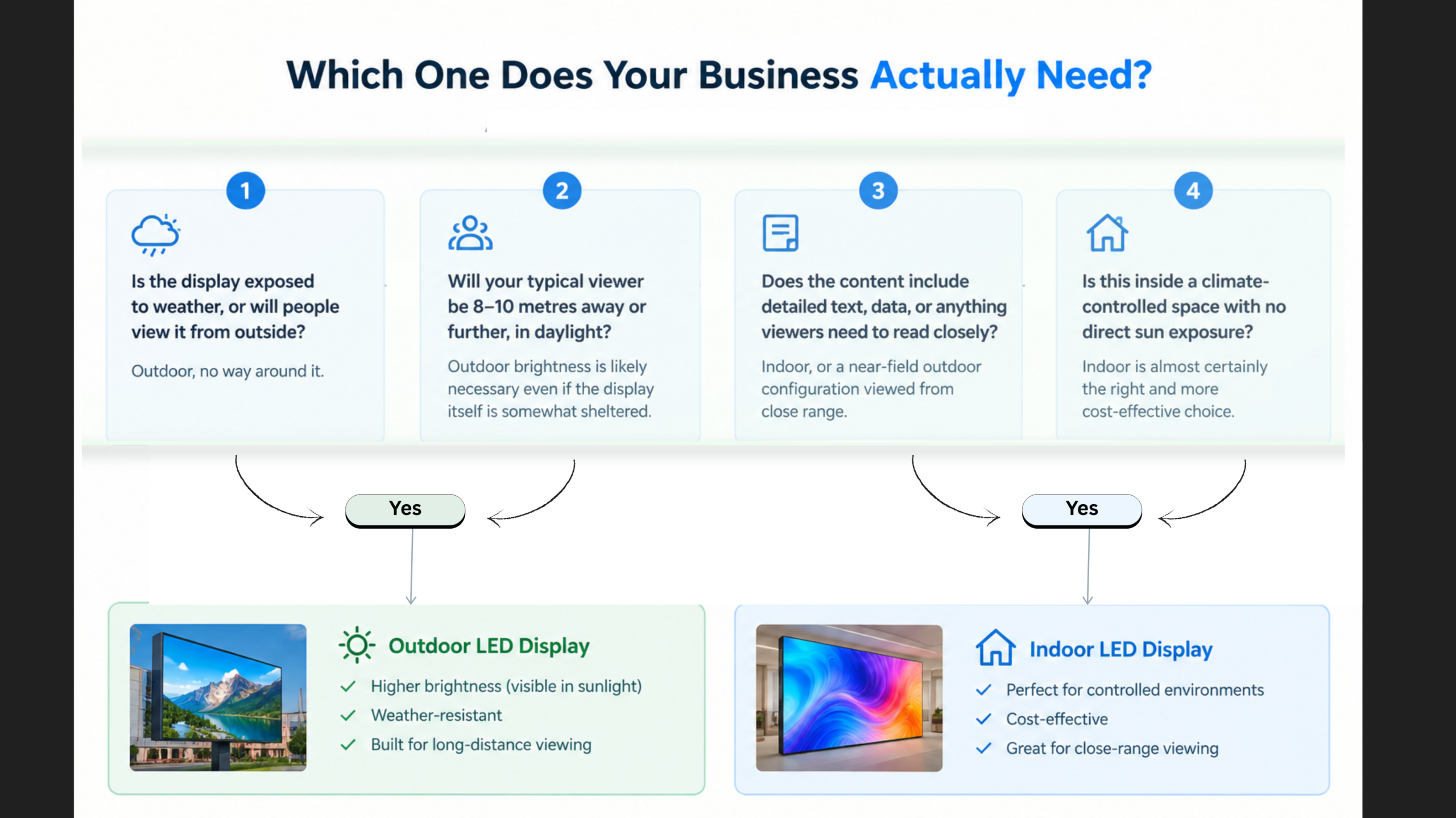
If you’re still unsure after these above four questions, that usually means the honest answer is a site assessment rather than a guess.
What This Looks Like for Retail, Corporate & Education
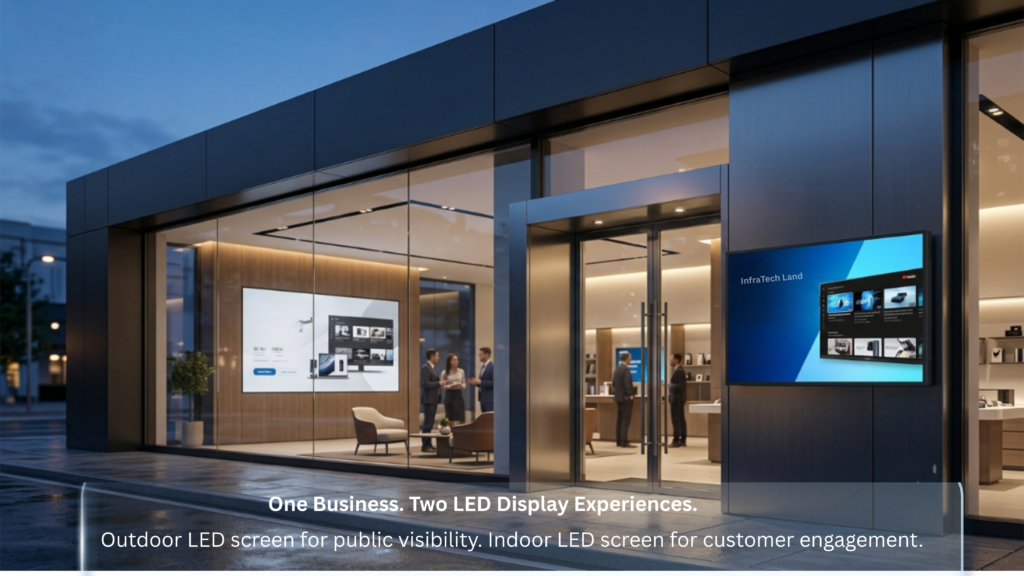
1. Retail (jewellery, textile, showrooms): This is the vertical most likely to genuinely need both: an outdoor-facing storefront or window display to pull in foot traffic, and an indoor wall on the showroom floor for close-up product presentation: gold, fabric texture, detail that only reads properly at short range.
See LED video walls for retail to understand the use cases in more detail.
2. Corporate: Overwhelmingly indoor boardrooms, lobbies, reception walls. Outdoor corporate use exists (large building facades, campus signage) but it’s a narrower case than most other verticals, and we won’t spec outdoor into a project that doesn’t call for it.
For a closer look at how LED displays will make a difference in corporate spaces, see LED video walls for corporate.
3. Education: Also predominantly indoor classrooms, auditoriums, lecture halls. Outdoor use is generally limited to campus entrance signage or wayfinding at larger institutions, not a default requirement.
Explore LED video walls for education to see how LED displays can be used across different educational spaces.
Can One Business Need Both?
Yes, and it’s more common than buyers expect — retail is the clearest example, but any business with both a public-facing exterior and a client-facing interior can have a legitimate case for both.
The two are specified, quoted and engineered completely separately; there’s no such thing as a single wall that does both jobs well.
How We Help You To Decide?
We start with the environment, not the catalogue:
- Where the display sits
- How far people typically view it from
- What it needs to show
That determines indoor or outdoor before pixel pitch, brightness, or budget enter the conversation which is also why our quotes don’t default to whichever category happens to be more profitable to sell.
Not sure which category your project needs? Get a free site assessment or WhatsApp us your location and use case for a faster first read.