- Home
- Indoor LED Displays
- Indoor LED Screen Display Buying Guide: Checklist for Your Businesses
Table of Contents
If you’ve decided you want an indoor LED video wall, this isn’t the article that convinces you further.
Think of it as a buying guide for the decision you’ve already made — the one that stops you from finding out, six months after installation, that you missed something a good vendor would have flagged upfront!
This is written from the buyer’s side of the table, not the sales side. Some of it will favour how we build things.
Most of it just reflects what we have seen go wrong on installations we did not do, and had to fix.
If you haven’t nailed down your pixel pitch or viewing distance yet, our pixel pitch guide and viewing distance guide cover that first.
This picks up once you know roughly what you need and are ready to compare vendors.
Phase 1: Define Your Requirements Before You Contact Any Vendor
- Room dimensions measured: width, height, and depth of clearance behind the intended wall location
- Closest and farthest viewer distance identified
- Primary content type decided: branding and video, or dense data and text
- Budget range set, and whether it's meant to cover hardware only, or hardware plus installation, structure, software and AMC
- Indicative pixel pitch shortlisted based on your closest viewer
Getting this phase right before the first vendor call changes the conversation.
You’ll be comparing quotes against your own requirements instead of accepting whatever spec each vendor leads with.
Phase 2: Verify the Technical Specification
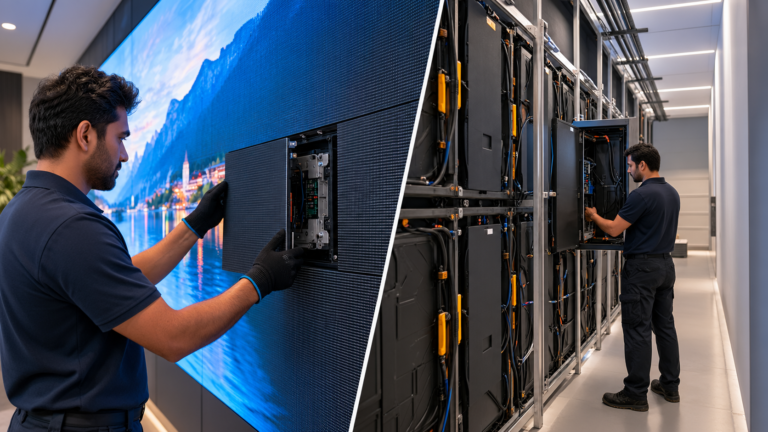
(i) Front Access vs. Rear Access
This decides whether your wall can be serviced without needing space behind it — a structural choice made before installation, not something you change afterward.
Most flush-mounted boardroom, lobby and retrofit walls have no rear clearance, which makes front access the only realistic option.
The question most buyers forget to ask: does “front access” in the quote cover the module only, or also the power supply and receiving card?
Some cabinets only support front removal for the visible module, which defeats the purpose if your wall has zero rear clearance.
For the full comparison that is mechanisms, real cost breakdown, and a scenario-based way to tell which your project needs, see our front access vs rear access guide.
(ii) Other Specifications to Check
- Cabinet material - die-cast aluminium holds up better long-term than lighter alternatives, particularly for heat dissipation.
- IP rating appropriate to the exact location - a lobby near an entrance or a semi-open reception area may need better protection than a fully enclosed indoor room.
- Refresh rate - matters if the wall will ever be filmed for events, webcasts, or social content, even occasionally.
- Brightness and calibration - matched to the room's actual ambient light, not a generic indoor default.
- Redundancy – what happens to the rest of the wall if one module or one power supply fails.
- Control processor and software - confirm what's included and how easy it is for your team to update content without calling the vendor every time.
Phase 3: Vet the Vendor, Not Just the Product
A strong spec from a vendor who won’t be around in three years is worth less than a slightly simpler spec from one who will.
- How many years has the company been installing LED video walls?
- Can you see verified reviews, not just testimonials curated on their own website?
- Does the company repair LED walls installed by other vendors? A company confident enough to fix competitors' installations usually has real technical depth behind the sales pitch.
- Do they have in-house service team or out-source, and what's the response-time SLA for your city specifically?
- Is installation done by the company's own trained technicians, or subcontracted out?
- Do they provide proper GST-compliant tax invoices with correct HSN classification?
LED display HSN classification is inconsistently applied across smaller suppliers in this category, so confirm this before you need input tax credit, not after.
Phase 4: Read the Commercial Terms Before You Sign
- Warranty period, and exactly what it covers: parts only, or parts plus labour and site visits
- AMC terms: what's included, the response-time SLA, and whether coverage is continuous after the warranty ends or leaves a gap
- The uncomfortable but necessary question: if a module fails in year four, will this vendor still exist, and will they still stock a compatible replacement panel?
- Compare the full quote, not the headline number: does it include structure, installation, content management software and AMC, or hardware only? Two quotes that look far apart on price are often quoting different scopes entirely.
Two similarly specified quotes rarely carry the same real cost over five years.
The gap shows up later, in downtime, in a vendor who’s stopped answering calls, or in a “cheap” wall that needed full replacement in year three.
Price the whole ownership period, not just the invoice.
Phase 5: Before Handover
- On-site training for whoever will operate the content and software day to day
- Full documentation: specification sheet, warranty certificate, AMC contract, as-built drawing
- Content management login and access confirmed and tested
- A scheduled 90-day check-in, not a one-time handover and goodbye
How We Answer This Checklist
We built this list from the questions we would want answered if we were buying, not the ones that flatter a sales pitch.
For the record, here’s where we stand against it – 11+ years installing indoor LED screens across India, 219 Google reviews, a 2-year warranty backed by pan-India AMC, in-house repair technicians.
And, even for the LED screens that we did not originally install and the quotes that separate hardware, structure, installation and AMC line by line rather than blending them into one number.
If you are planning LED screen for your business, then get a detailed quote or WhatsApp us your room details for a faster first read.