- Home
- LED Display Guides
- How to Plan an LED Video Wall for a Retail Store
Table of Contents
Most retail LED screen projects start the same way: a free stretch of wall and a budget. The ones that earn their cost start from a different question — what should this screen change about how a customer moves through, stays in, and buys from this store?
This guide is a planning sequence for retail store owners and managers, from a single boutique to a multi-floor showroom.
It comes from 11+ years of specifying and installing LED video walls for retail across India, and it’s ordered deliberately: the decisions go in the sequence they should be made, because the sequence is where many projects go wrong — specification before objective, wall before customer path, hardware before content.
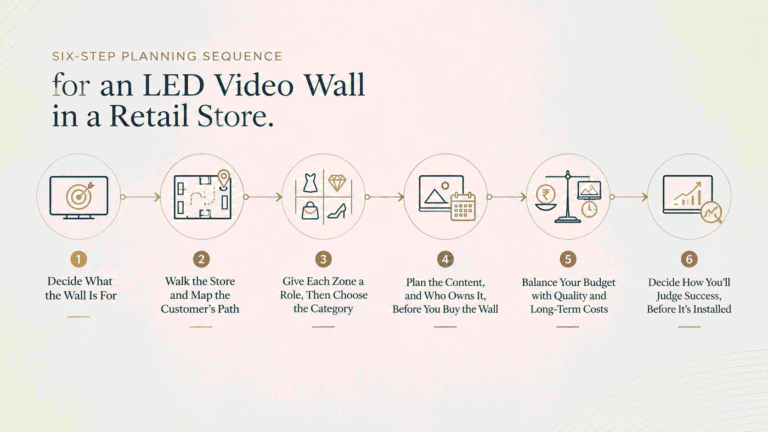
1. The plan at a glance
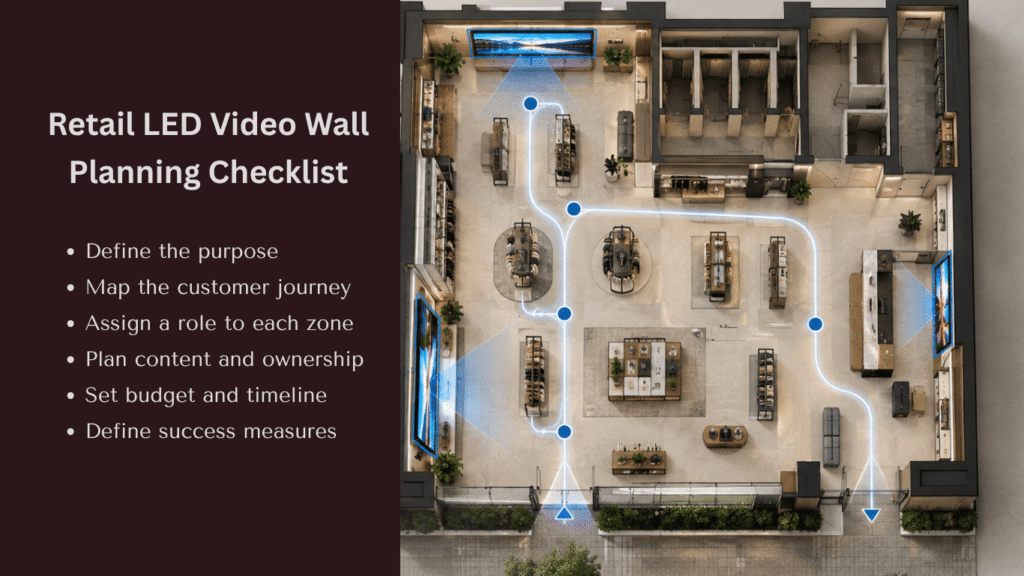
- Decide what the wall is for
- Walk the store and map the customer's path
- Give each zone a role, then choose the category
- Plan the content, and who owns it
- Set the budget and the timeline together
- Decide how you'll judge success before installation
Step 1: Decide What the Wall Is For
A wall can do several jobs, but not all of them well at once. Choose one primary objective and, at most, one secondary:
- Pull footfall in from the street or the mall corridor
- Lengthen the time customers spend on the floor
- Push particular categories or higher-margin lines
- Tell the brand or craft story that justifies your pricing
- Make waiting at trial rooms, billing, consultations feel shorter
- Carry content from brands you stock, if you run a multi-brand store
That last one is optional, but decide it now: if brands might fund content slots, the content system has to schedule them cleanly, and that changes what you buy.
The objective drives everything after it:
- Where the wall goes
- How big it is
- What runs on it
- How you will know whether it worked
A wall meant to pull footfall belongs at the frontage and needs brightness. A wall meant to tell a craft story belongs where customers pause, and needs detail.
Step 2: Walk the Store and Map the Customer's Path
Before looking at a single spec, walk the store as a customer would: from the street (or the mall corridor), through the entrance, across the floor, to billing.
Do it on a busy day and a quiet one, and mark four things:
- a) Where people slow down or stop — displays, counters, seating, trial rooms
- b) Where people wait — queues, consultations, seats for family members who've come along
- c) What a customer sees at eye level from the entrance and from each dwell point — your real sightlines, not the floor plan's
- d) Where light interferes — window glare, spotlights, reflective finishes
Then check what’s physically behind each candidate wall: power, structure, and whether anyone could ever get behind it to service it.
Our installation requirements guide and front access vs rear access guide cover that side.
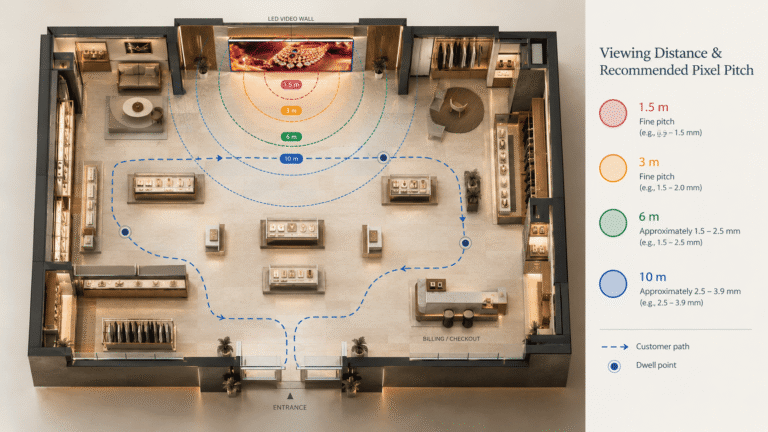
The rule that falls out of this: put the wall where attention already is, not where there happens to be spare wall.
Step 3: Give Each Zone a Role, Then Choose the Category
Before you lock any row, measure the closest and farthest viewer distance in that zone, our viewing distance guide shows how, and the technical reference has the full maths.
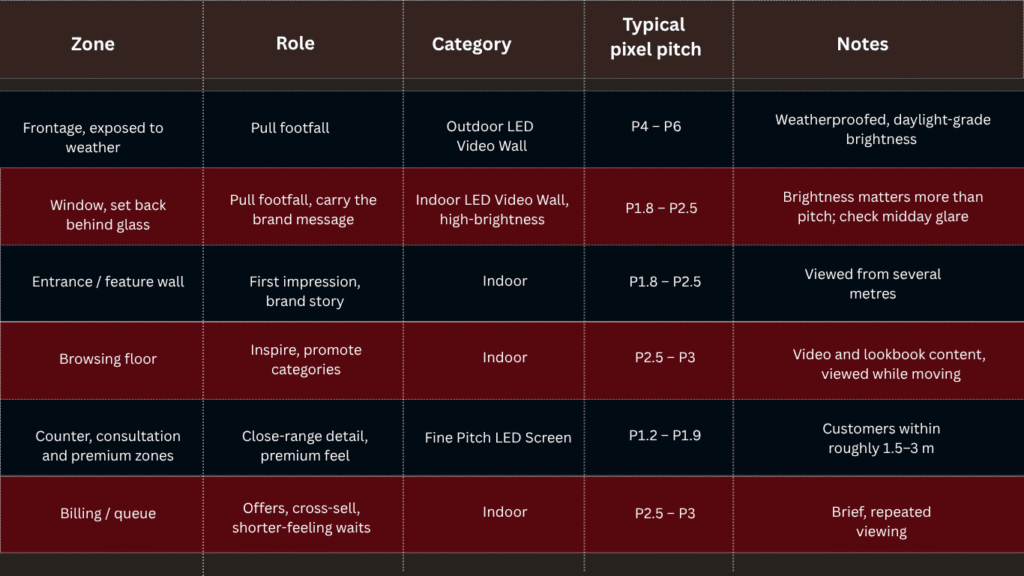
Then ask whether the zone really needs the category you have assigned.
Most stores end up with one or two categories across their zones, not all three; do not pay for outdoor-grade or fine-pitch capability in a zone that does not need it.
Step 4: Plan the Content, and Who Owns It, Before You Buy the Wall
The LED wall is a one-time purchase. The content is a permanent commitment. Settle four things before you choose hardware:
a) What runs, and how often it changes?
Collection launches, festive and seasonal campaigns, offers, brand film and a refresh cadence you can realistically keep up.
b) Who makes it?
In-house, an agency, or a mix. Content production is a real budget line, not a footnote.
A wall with no budget for fresh content ends up repeating its launch graphic.
c) How it’s managed?
One store or several? If several, content should be pushed centrally, not updated store by store.
Remote support for software and technical issues also matters more than it sounds when whoever manages the content isn’t a technician.
d) How it’s designed?
A wall is read in seconds, from a distance, usually by someone doing something else.
Large type, short loops, one idea per scene. Content built for a phone screen or a flyer rarely survives the translation.
Step 5: Balance Your Budget with Quality and Long-Term Costs
When planning an LED video wall for your retail store, it’s tempting to choose the lowest quotation and stay within budget.
But the initial purchase price is only one part of the investment.
Two LED video walls may look similar on paper, yet differ in image quality, component quality, brightness consistency, power consumption, maintenance requirements and after-sales support.
These differences can affect how well the display performs after installation and what it costs to maintain over time.
- A lower quotation can save money upfront, but it may not offer the best value over the life of the display.
Before comparing prices, look at what each vendor is actually offering:
- Display quality: Check the clarity, colour consistency and brightness required for your retail environment.
- Product and component quality: Understand the specifications of the LED modules, power supplies and other key components.
- Installation and service: Confirm what’s included in installation, commissioning, warranty and after-sales support.
- Long-term operating costs: Consider electricity consumption, maintenance needs and the availability of service support.
A quotation should also account for the complete installation, not just the LED wall itself.
Structure, electrical work, control systems, content preparation and any additional site requirements can affect the final cost. Ask vendors to clarify these inclusions so you’re comparing equivalent solutions.
- Don't Compare Price Without Comparing Specifications
If one vendor quotes significantly less than another, ask what’s different before making a decision.
Are the specifications the same? Is the installation included? What warranty and service support are provided? Are there any additional costs?
A higher quotation isn’t automatically better, just as a lower quotation isn’t automatically a bargain. The important thing is understanding what you’re paying for and whether it meets your store’s requirements.
At Vivid LED System, we recommend choosing the specification based on your space, viewing distance, content and operating conditions, not simply opting for the highest specification or the lowest price.
Step 6: Decide How You'll Judge Success, Before It's Installed
If you don’t define success in advance, the wall gets judged on impressions; someone says it looks good and then quietly stops being managed.
Pick two or three measures that match your Step 1 objective, and record a baseline before installation:
- If your objective is:
- Then measure:
Pull footfall
Door counts (if you have a counter), and walk-ins who mention the display
Lengthen browsing
Time spent in the zone — a staff tally on sample days, before and after
Push categories
Sales of the featured categories in weeks with and without wall content
Tell the brand story
The questions customers ask, and what your floor staff report
Shorten waiting
Customer comments about waiting, and time at billing
Add two operational measures whatever your objective: wall uptime, and whether content is actually being refreshed on schedule.
A wall rarely produces one clean number, and any promise of a fixed percentage uplift deserves suspicion. Simple, consistent before-and-after comparisons are more honest and more useful.
2. Planning for Luxury Retail?
Luxury retail changes the brief: the wall has to belong to the space, not announce itself.
The requirements that matter most:
- a) Fine pitch for close viewing >>>
In boutique and counter zones, customers are often within roughly 1.5 to 3 metres, so P1.2–P1.8 is the usual starting range.
Our fine pitch LED range is built for this.
- b) Looks right at low brightness >>>
In calm, dimly lit interiors, a close-viewing wall usually runs well below its peak. Ask about greyscale performance at low brightness — weaker panels lose tonal detail when dimmed, which shows first in dark, rich content.
- c) Reads as architecture >>>
Flush mounting, clean edges, concealed cabling, and a finish that suits the store’s materials. This is where front-access servicing earns its place: a flush wall with no rear corridor can still be repaired without opening up the surrounding walls — see our front access vs rear access guide.
Confirm the exact clearance behind the wall with your vendor.
- d) Quiet >>>
In a hushed showroom, fan noise is as noticeable as a flickering light.
Ask about operating noise!
- e) Colour you can trust >>>
Calibration, and uniformity across the whole surface, so no module ever looks a shade different from its neighbour.
- f) Editorial content, not promotions >>>
A luxury wall works best with slow, cinematic, brand-led content — closer to a fashion film than a sale banner. Fewer scenes, held longer, made well.
3. Your One-Page Planning Worksheet
- What is the wall's one primary objective?
- Where do customers slow down, wait and look and which of those spots will carry a wall?
- What role does each zone play, and which category (indoor, outdoor, or fine pitch) does each need?
To understand more about different types of LED screen solutions, you can check indoor, outdoor and fine pitch LED video wall use cases.
- What are the closest and farthest viewing distances in each zone?
- What will run on the wall, who produces it, and how often does it change?
- Does the budget cover structure, installation, content management, and AMC not just panels?
- What's your live-by date, and what does the written timeline look like working back from it?
- How will you measure whether it worked, and what's your baseline today?
If you can answer these, any competent vendor can give you a precise quote. If you can’t, that’s what a site assessment is for.
4. How We Plan Retail Projects
We run this same sequence on every retail project: objective, customer path, zones, content, budget, measures — before a spec is written.
That’s why our LED experts walk clients through the complete investment, from hardware and installation to content management, maintenance and after-sales support.
Every installation comes with a 2-year warranty, AMC, in-house repair and remote support, backed by 11+ years of experience across India and 219 Google reviews.
Already have a wall that isn’t working? We service and repair LED walls installed by other vendors too.
Planning a retail LED wall and want a second pair of eyes on the plan?
Get a free site assessment or WhatsApp us your store layout and a few photos for a faster first read.